
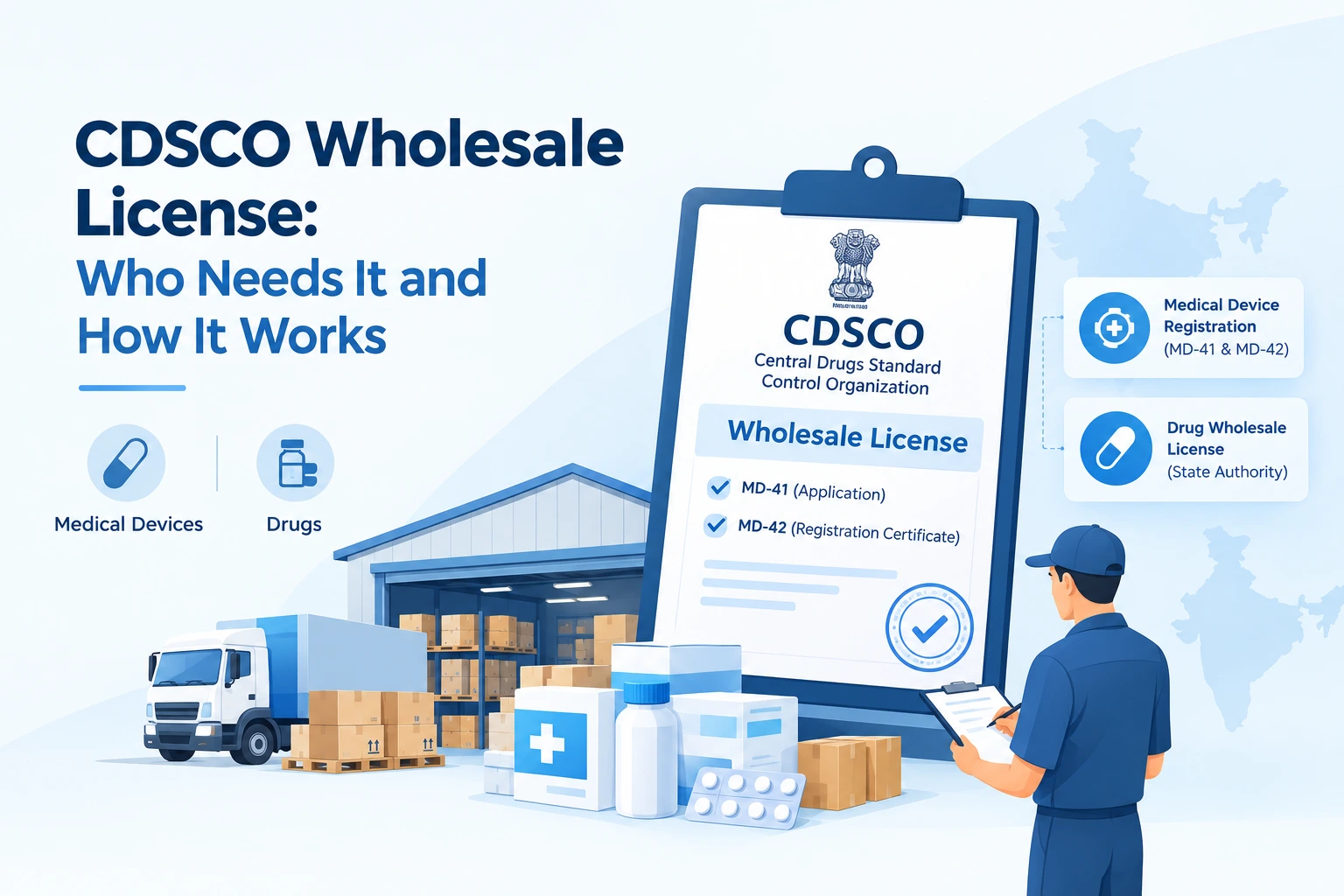
Search for a “CDSCO wholesale license” and you will find pages that use the term in quite different ways. Some mean a licence to wholesale medical devices. Others mean a licence to wholesale medicines. Most view the Central Drugs Standard Control Organization (CDSCO) as the authority that grants the license which is only somewhat accurate.
One should know about the meaning of license and who is responsible for it ahead of planning the premises, hiring staff and doing paperwork. This guide helps clarify that and address the issue from a practical perspective.
What People Mean by a CDSCO Wholesale License?
The Central Drugs Standard Control Organization (CDSCO) is the authority in charge of overseeing drugs and medical devices in India. It creates the national compliance system and grants import and manufacturing permission, and liaises with state authorities. However, the licensing of wholesale trading is done by state regulators, as it is done in the State Licensing Authority.
When someone refers to “CDSCO wholesale license”, the person is usually talking about
- A registration for medical devices which is obtained by submitting an application form MD-41 and obtaining a registration certificate MD-42 as per the rules related to medical devices
- A wholesale license granted to drugs based on rules on drugs and cosmetics by the state drug licensing authority
The first license is the type that is in demand today among many businesses involved in the supply of medical devices. The second license is meant for companies that deal with medicines. Many companies do both and obtain permission to perform the activities.
Reasoning behind Regulation of Wholesale Layer
It is possible for a medical product to be made in a proper manner, however when it is stored inadequately or sold through unauthorized channels, it becomes hazardous. Therefore, the suppliers of products to other actors in a supply chain include wholesalers, who purchase products in large quantities, store and keep them in their warehouses and send them further to medical facilities including clinics and hospitals.
All of this points out that the regulations are interested in three important factors: where the products are stored, who is accountable for them, and how the purchase and sale records are kept. The license is nothing else but a verification tool for ensuring that products are sourced in the right way.
Who Needs a Wholesale License?
This license needs to be taken into account for your business if:
- You acquire medical devices from manufacturers or importers and do bulk distribution later
- You function as a stockist, distributor or supply partner for a device brand
- You import devices and distribute them through your own warehouse afterwards
- You supply hospitals, nursing homes, pharmacies or other trade buyers on a large scale
You sell medical devices through an online marketplace where platforms typically request proof of the required registration before allowing listings
It does not replace a manufacturing or import licence. If you make devices or bring them into the country, those activities need their own approvals, such as the MD-3/MD-5 manufacturing licence or the MD-14/MD-15 import licence. The wholesale licence covers only the trading and storage activity.
MD-41 and MD-42 Explained
The two form numbers cause more confusion than any other part of this topic, so here is the short version.
Form MD-41 is the application. You complete it with your business details, premises information and supporting records, and submit it to the State Licensing Authority.
Form MD-42 is the outcome. It is the registration certificate issued once the authority is satisfied that you meet the requirements.
Professionals often say “MD-42 licence” and “wholesale licence” interchangeably, which is fine as long as you know the form behind the name. For a closer look at the service itself, see our MD-42 wholesale licence page.
What the Authority Looks At
Different states have different requirements but they all involve similar elements.
Legal entity. The applicant has to be a legitimate entity of any form such as a corporation, LLC, partnership, or sole proprietorship with an appropriate legal entity.
Facility. The warehouse should be fit for storing goods and clean, safe, and spacious enough. In many cases, inspectors carry out their procedures before granting permission to establish your business.
People. The person chosen to run the business is expected to be responsible for the operations and for making sure that they are legal.
System. You will need to demonstrate how your purchases, inventory, and sales are recorded and thus tracked.
Sourcing. The equipment should be obtained from Registered manufacturers or importers but not from anonymous sellers.
A Simple Path Through the Process
The procedure is uncomplicated if one follows through correctly.
The first step is to establish suitable licenses and the type of goods to be handled. Next, one must find a proper place and assign a person to assume responsibility. The next stage is to prepare all the documents required, such as an application, proof of company existence, premises information, personnel, and declarations. Then the application should be lodged according to the specific procedure provided by the state, pay the government fee of ₹3,000, and wait for the government to conduct a review of the case, and in most cases, an inspection. After the completion of the procedure, one is awarded the license.
As the process can vary from state to state, having local knowledge of how the department works will help to speed things up.
Mistakes That Hold Applications Back
Picking out locations before checking requirements. Signing a rental agreement before realizing that the premises don’t comply with warehouse regulations results in an expensive lesson.
- Mixing the type of licenses. A wholesaler license in drugs is not the same as the registration of the equipment. One does not mean the other.
- Poor documentation. Missing signatures, contacts, and lack of proof is one of the leading causes of queries.
- Overlooking the inspection. Badly prepared warehouses, missing documenting systems, or an unavailable person can spoil the whole application.
- Purchasing from untested suppliers. After the license is awarded, sourcing the products from unlicensed suppliers might lead to losing the license.
- Ignoring the ongoing responsibilities. Keeping records, displaying the license, and following the right trading practice continues after getting the license.
What After the Licence
Receiving the certificate marks an important achievement, but it should not be seen as an end point. Not only does certificate ownership require the keeping of records and maintaining products, but sources must also be duly authorised. Any changes in the physical location, in the responsible party or in the business structure need to be communicated to the authority. Ignoring those obligations could lead to suspension or cancellation of the certification.
How E2E Compliance Advisors Can Help
In theory, wholesale well licensing may seem simple and easy, yet small issues may cause delays. E2E Compliance Advisers professionals can assist in selecting the right license, checking your premises as per the requirements, completing license-related documents, applying for MD-41, and maintaining communication with the Licensing Authority until the license has been received.
We also look at the bigger picture. If you plan to import devices, we can support the licensing at that end too, along with CDSCO registration and, for businesses dealing in medicines, the drug licence and retail drug licence routes. A single team handling the whole chain means fewer handoffs and fewer surprises.
Final Thoughts
The wholesale license remains a virtually invisible core element of a legitimate distribution business. It protects your customers, the brands you represent, and the business you are establishing. Knowing who issues it, which form to use and what the authority anticipates will enable many months of unnecessary work to be avoided.
Frequently Asked Questions
1. Does CDSCO grant the wholesale license by itself?
No. CDSCO has established a national system to carry out the regulatory affair, but the actual decision on wholesale registration is taken by the State Licensing Authority.
2. What is the difference between MD-41 and MD-42?
MD-41 is the application and MD-42 is the approval certificate.
3. Is wholesale license equal to manufacturing or import license?
No. Wholesale license concerns only transportation and storage of the goods but any manufacturing and import activity requires a separate approval.
4. Do I need a separate permission for medicines and medical devices?
Yes. Medications and medical devices are regulated through different regulations, so if you are working with both of them you should comply with both.
5. Will my premises be checked?
Most state institutions carry out inspection before granting approval, so it makes sense to prepare the place and documents in advance.
6. Are E2E Compliance Advisors able to help?
Yes. We will support you throughout the entire process, from the moment of obtaining a license and collecting documentations to submitting and coordinating with the regulatory authority.