
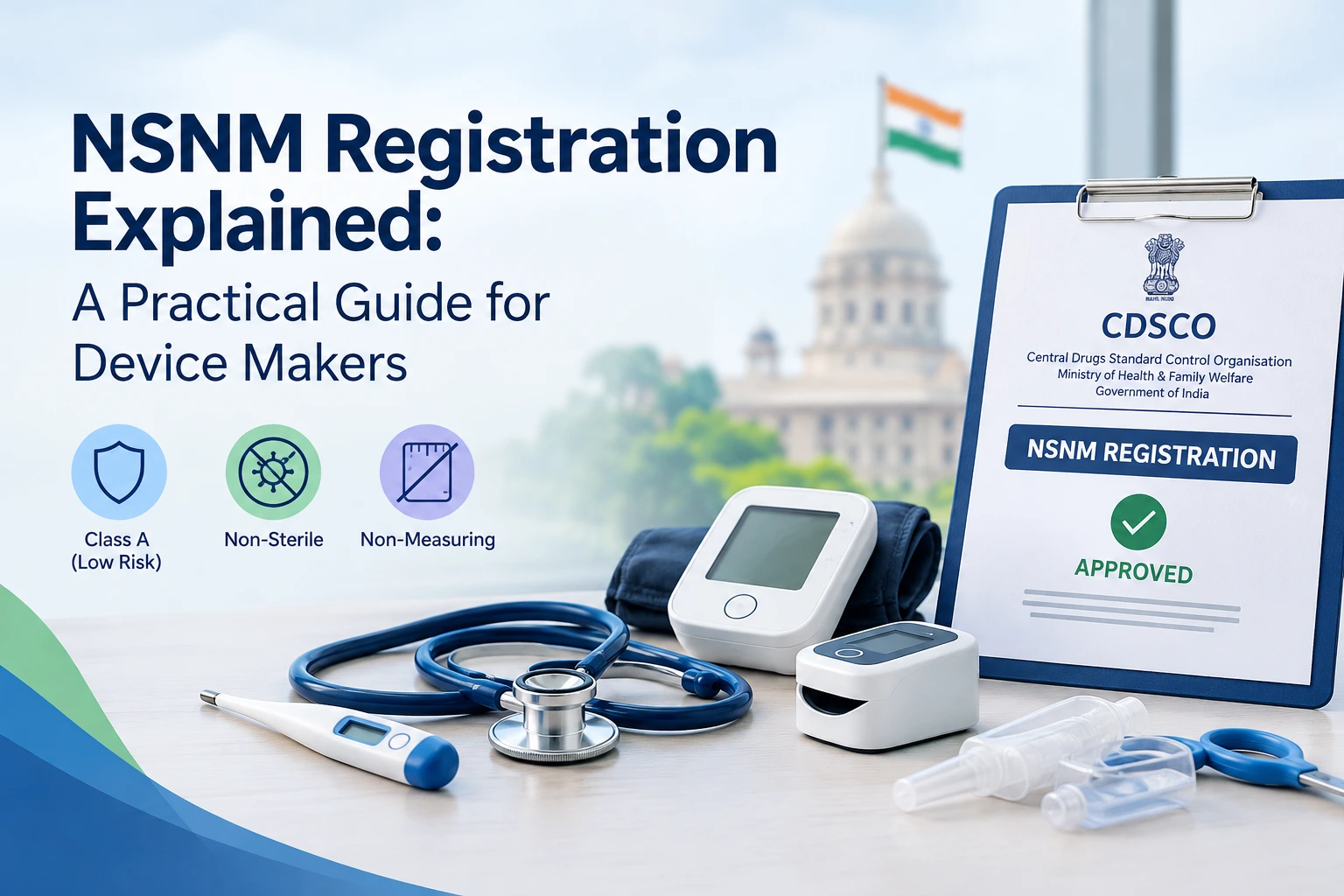
Releasing a healthcare product in India can be a daunting process, full of specifications and approvals. Fortunately, the obstacles may differ greatly depending on the type of product. Some medical devices are much less regulated than others; as a result, rules governing NSNM registration reveal an unequal burden of proof placed on different devices.
The present article addresses the notion of NSNM registration, its reasons and relevance for manufacturers, as well as key points to be taken into consideration.
The Idea Behind NSNM
Medical devices in India are categorized according to their risk. In fact, the greater the danger that a device represents if it goes wrong or is improperly used, the more thorough the inspection that regulators do. The less harmful devices are Class A devices that pose the lowest risk to users.
There are two key traits that render these devices particularly easy to regulate: they are kept unsterile and do not measure anything. These are called Non-Sterile Non-Measuring (NSNM) devices. As a result, the CDSCO uses registration for the approval of these devices instead of licensing.
The rationale for this is obvious. Sterility is a complicated process and measurements require precision so the failure of a device has more severe consequences. On the other hand, devices without either of these two properties are easier to regulate and pose considerably less risk.
NSNM Registration vs a Full Licence
Many first-time founders assume that every medical device needs a manufacturing or import licence. That is not always true. Here is how the two pathways differ in spirit:
| Aspect | NSNM registration | Full licence route |
|---|---|---|
| Typical devices | Low-risk, non-sterile, non-measuring Class A products | Higher-risk classes, or Class A products that are sterile or measuring |
| Regulatory approach | Declaration and registration through CDSCO’s online system | Detailed application, document scrutiny and, in many cases, inspection |
| Effort involved | Lighter, but accuracy of the declaration matters greatly | Heavier and more technical |
| Proof of compliance | Registration number shown on the label | Licence issued for the specific activity |
Choosing the wrong route in either direction is costly. Applying for a full licence when registration would do wastes effort. Registering a device that actually needs a licence, on the other hand, leaves you exposed to regulatory action.
Who Should Pay Attention?
Businesses that may find the NSNM registration useful include:
- Manufacturers of simple Class A goods located in India
- Importers who import such kinds of goods from overseas manufacturers
- Businesses which are being established and preparing to develop a product framework
- Companies dealing with trading business that needs to understand whether the goods from the company’s possession are of legal origin
If you belong to any of the categories above, knowing what the NSNM is can save you a lot of time wasted on mistakes.
Checking Whether Your Product Qualifies
There is no shortcut to achieving eligibility. It depends on the classification of the device and its design, condition of supply, and its functioning. Start asking these questions:
Is the risk low? The device should belong to the lowest risk class according to the Medical Devices Rules.
Is it non-sterile? If the device is packed or sold in sterile conditions, then it is usually out of scope of NSNM.
Is it measuring? Any measuring capability, even if basic, will remove the device from this category.
Keep in mind that similar products may have different classifications and one of them may fall outside of the category. Simple mechanical device and its measuring version will be classified differently. The classification may also change along with the intended purpose or packaging.
What Does the Registration Process Look Like?
While this procedure is simpler than obtaining a full license, it still requires a lot of hard work.
First, you will have to figure out the classification and decide to which category to assign it. Next, you will need to gather all the documents related to the business and product, which are required by the system. These include proof of ID and address of the business, the name of the product and its proposed use, the details of the label, and for exporters, the name and authorisation of the manufacturer. Next, all information will be sent online through CDSCO, and once the application is accepted, you will get your registration number. Afterwards, you will have to display this number on the label of your product in order to sell it.
Five Mistakes Worth Avoiding
Relying on appearance. A device that looks basic is not automatically NSNM.
Ignoring the sterile angle. Even a simple product becomes a different case if it is supplied sterile.
Mismatched documents. The product name on the application, the label and the brochure should agree.
Missing label compliance. A registration that never makes it onto the label does not do its job.
Forgetting about change. New variants, modified designs or fresh import sources may need a fresh look at your registration.
Why a Regulatory Partner Helps
Although in principle, it seems easy to think of registration as a rather primitive form of processing paperwork, yet in reality, the major challenge comes with what regards classification of goods. Here is where experience counts. A qualified consultant will take a look at the product in the same way as the registering authority and will foresee possible objections.
E2E Compliance Advisors works across CDSCO manufacturing and import licences, IVD approvals, cosmetic registrations, BIS certification and EPR requirements. That breadth means we can tell you quickly if your product belongs in the NSNM route or needs something more, such as a CDSCO registration, an MD-3/MD-5 manufacturing licence or an MD-14/MD-15 import licence. If you plan to import, we can also help with your Import Export Code.
Final Thoughts
The process of registering NSNM is a responsible and reasonable element of India’s system for medical devices. It provides incentives to those companies that demonstrate expertise in their products and show integrity in their declarations. The most important thing is to classify the product correctly from scratch and keep the labels and other documents in alignment.
Frequently Asked Questions
1. What is the full form of NSNM?
NSNM stands for Non-Sterile, Non-Measuring, and describes a category of low-risk Class A medical devices.
2. Why does NSNM registration exist?
It gives low-risk devices a simpler path to market, so regulators can focus their scrutiny on products that carry greater risk.
3. Can an importer apply for NSNM registration?
Yes. Importers of eligible devices must register too, usually with documents from the overseas manufacturer.
4. Is the registration number mandatory on the label?
It is expected to appear on the label of the device sold in India.
5. What if your device is present sterile or has the functionality of measurement?
Then the device would not fit into the NSNM category and will need to have a licence via appropriate route.
6. How would E2E Compliance Advisors assist?
We assess your products, determine the most suitable arrangement, prepare documents, submit applications and manage how you label the products.